

Microsoft is making one of its largest country specific technology plays yet, announcing a 19 billion Canadian dollar investment in AI and cloud infrastructure in Canada between 2023 and 2027. More than 7.5 billion dollars of that is planned for the next two years. The plan, outlined by Microsoft Vice Chair and President Brad Smith, combines new data center capacity, a structured “digital sovereignty” framework, and a major expansion of AI skills programs across the country.

A large share of the new spending is directed at physical infrastructure. Microsoft is expanding its Azure Canada Central and Azure Canada East data center regions. These facilities will provide additional cloud and AI capacity hosted within Canadian borders for both public and private sector customers. The company says the new and expanded sites are being designed to be energy efficient, use more renewable energy, and reduce water consumption through improved cooling systems.
These efforts are tied to Microsoft’s global goals to become carbon negative, water positive, and zero waste by 2030. The firm also highlights its investments in Canadian clean technology companies such as Eavor, Cyclic Materials, Arca, Deep Sky, and Carbon Engineering, which are working on carbon removal and related technologies.
Canada’s AI economy is a major sector of growth, driving innovation, job creation and investment. Canada is scaling homegrown companies while also working with international partners to build the advanced infrastructure our innovators require.
Honourable Evan Solomon,
Minister of Artificial Intelligence and Digital Innovation
Microsoft argues that this infrastructure build out is already translating into thousands of construction and engineering jobs and is supporting modernization across industries. It points to Canadian Tire, Manulife, BMO, and Gay Lea Foods as examples of organizations using cloud and AI services to transform operations in sectors ranging from retail and financial services to food and agriculture. The company also links its data center expansion to emerging fields such as cleantech and quantum computing, where reliable high performance infrastructure is seen as a prerequisite for growth.
Security and data handling are the second major focus of the plan. Under what it describes as a five point framework, Microsoft says it will prioritize defending Canadian cybersecurity, keeping more data on Canadian soil, strengthening privacy protections, supporting local AI developers, and ensuring continuity of cloud and AI services. The company reports that it has seen more frequent targeting of Canadian systems by state backed actors and organized criminal groups, with attacks aimed at government agencies, critical infrastructure, and sectors such as health care and education. In response, Microsoft is opening a Threat Intelligence Hub in Ottawa that will host specialists in threat intelligence and applied AI security. They will work with the federal government and law enforcement using Microsoft’s global threat data to track and disrupt hostile activity.
On data residency, the firm plans three key steps in 2026. It will expand in country processing for AI assistant interactions so more data is handled entirely within Canada. It will broaden its Azure Local offering so customers can run Azure capabilities in their own private or on premises environments. It will also introduce a Sovereign AI Landing Zone for Canada, described as an open source blueprint that gives organizations a secure foundation for deploying AI systems while staying within Canadian borders and meeting privacy and compliance requirements.
Microsoft is pairing these measures with new technical and legal privacy protections. It intends to bring confidential computing capabilities to its Canadian regions, which keep data encrypted even while it is being processed, and to offer Azure Key Vault services so Canadian customers can control their encryption keys either locally or through trusted hardware modules. The company says it will embed in contracts a commitment to challenge government demands for Canadian government or commercial customer data where it believes there is a legal basis to do so. It also stresses that its Canadian infrastructure “is not built on wheels” and is fully subject to Canadian law and regulation.
Another part of the trust agenda is support for Canada’s own AI ecosystem. Microsoft is deepening its partnership with Toronto based Cohere by adding Cohere’s language models, including Command A, Embed 4, and Rerank, to its lineup of models available on Azure. The company says it will explore further ways to integrate “sovereign, made in Canada” AI models into Microsoft services so domestic enterprises and public sector organizations can use locally developed AI that reflects Canadian standards and priorities.
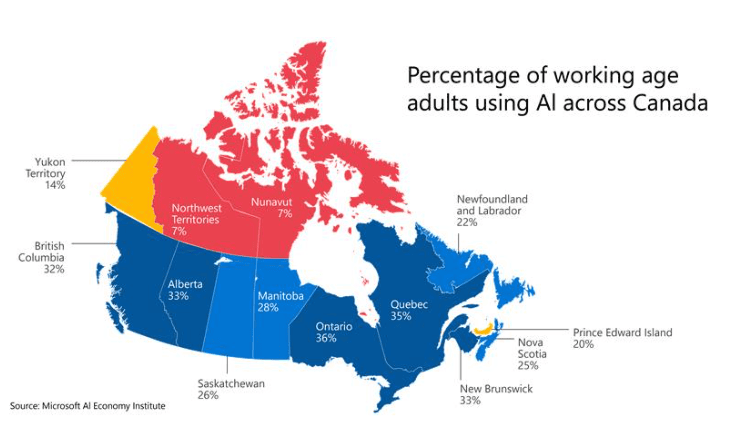
The third pillar of the announcement is talent. Microsoft highlights a growing skills gap, noting that by 2030 nearly 60 percent of workers worldwide will need new digital skills, yet only 24 percent of Canadians have received any AI training so far compared with a global average of 39 percent. To address this, Microsoft has launched Microsoft Elevate, a unit focused on AI and digital skilling. Since July 2024, the company reports that 5.7 million learners in Canada have engaged with its free programs and that more than 546,000 people have completed at least one AI course. By 2026, Elevate aims to help 250,000 Canadians gain AI related credentials.
Partnerships are central to this skills push. The Nonprofit AI Impact Hub, created with the Canadian Centre for Nonprofit Digital Resilience and Imagine Canada, is designed to help the country’s 170,000 charities and nonprofits adopt AI through role based training and micro credentials. A new collaboration with youth organization Actua will support AI Ready and InSTEM programs for 20,000 young Canadians, including Indigenous youth. These programs introduce AI skills while also showing how technology can support local priorities, such as preserving Indigenous languages and cultural knowledge.
For more than 40 years, Microsoft has grown alongside Canada, and I look forward to continuing this collaboration for many years to come.
Brad Smith
Vice Chair and President at Microsoft Corporation
The announcement is framed as the next chapter in a relationship that goes back four decades. Microsoft opened its first Canadian office in Toronto in 1985. Today the company employs more than 5,300 people in 11 cities, including Toronto, Vancouver, Montreal, Calgary, Edmonton, Ottawa, and Quebec City. “Over four decades, our company and our thousands of employees have grown alongside Canada,” Smith wrote, calling the new package “the most important commitment in Microsoft Canada’s history.” According to third party estimates cited by the company, more than 17,000 Canadian firms now operate as Microsoft partners, generating between 33 and 41 billion dollars in annual revenue and helping support about 426,000 jobs nationwide.
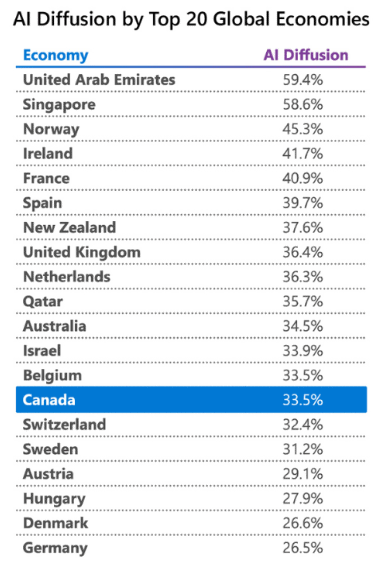
The announcement also sits within a broader global context. Canada has been a key player in AI research for years and today ranks 14th worldwide for AI adoption and for AI related code contributions on GitHub, according to Microsoft’s own AI Diffusion Leaderboard. In a statement included in the announcement, the Honourable Evan Solomon, Canada’s Minister of Artificial Intelligence and Digital Innovation, described AI as “a major sector of growth” for the country, adding that Microsoft’s commitment “shows continued belief in Canada’s talent, economy and AI ecosystem” and will help “grow the next generation of Canadian AI champions.”